Components and functions of supervision

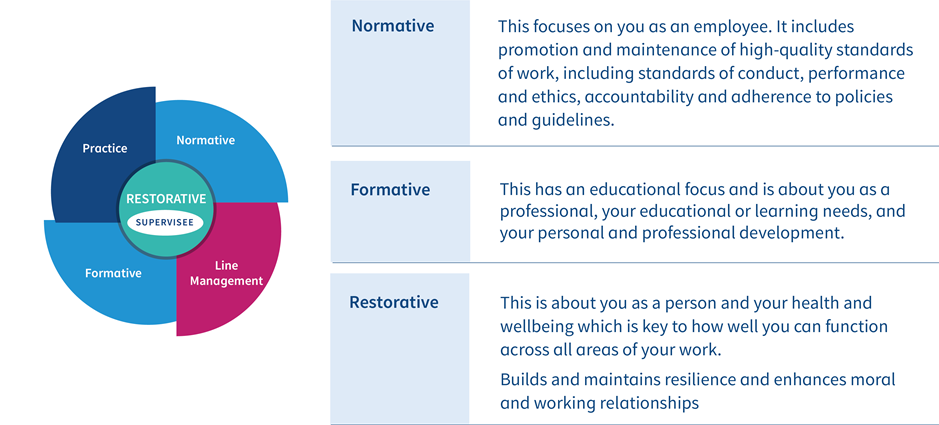
The two key components of supervision are practice / professional supervision and line management supervision. Diagram 2 highlights this and notes that these should be underpinned by Proctor’s model.
Diagram 1 - the two components of supervision.
Practice / Professional Supervision: Formerly referred to as Practice/Clinical Supervision. This component aims to ensure best practice in relation to all aspects of our work and is concerned with the complexities of the speciality where you work, your role or your area of expertise, which may be clinical, management, education, research or role in industry. This component should be provided by someone from your own profession or clinical background, or someone with expertise in the area you work.
Line Management Supervision: This focuses on areas such as mandatory and statutory training and the day to day running of a service and how the staff engage with the organisation’s function, for example, organisational change, resourcing issues and the implications for a person’s role. This could be provided by someone from a different profession or clinical background.

Functions of Supervision
Proctor’s model of supervision (cited in Clinical Supervision Toolkit Helen and Douglas House 2014, Pollock 2017) applies to both components of supervision, and describes three key functions of supervision. These functions relate to:
- you as an employee (normative)
- you as a professional (formative)
- you as a person (restorative)
The three functions are – normative, formative and restorative and are described in Diagram 2.